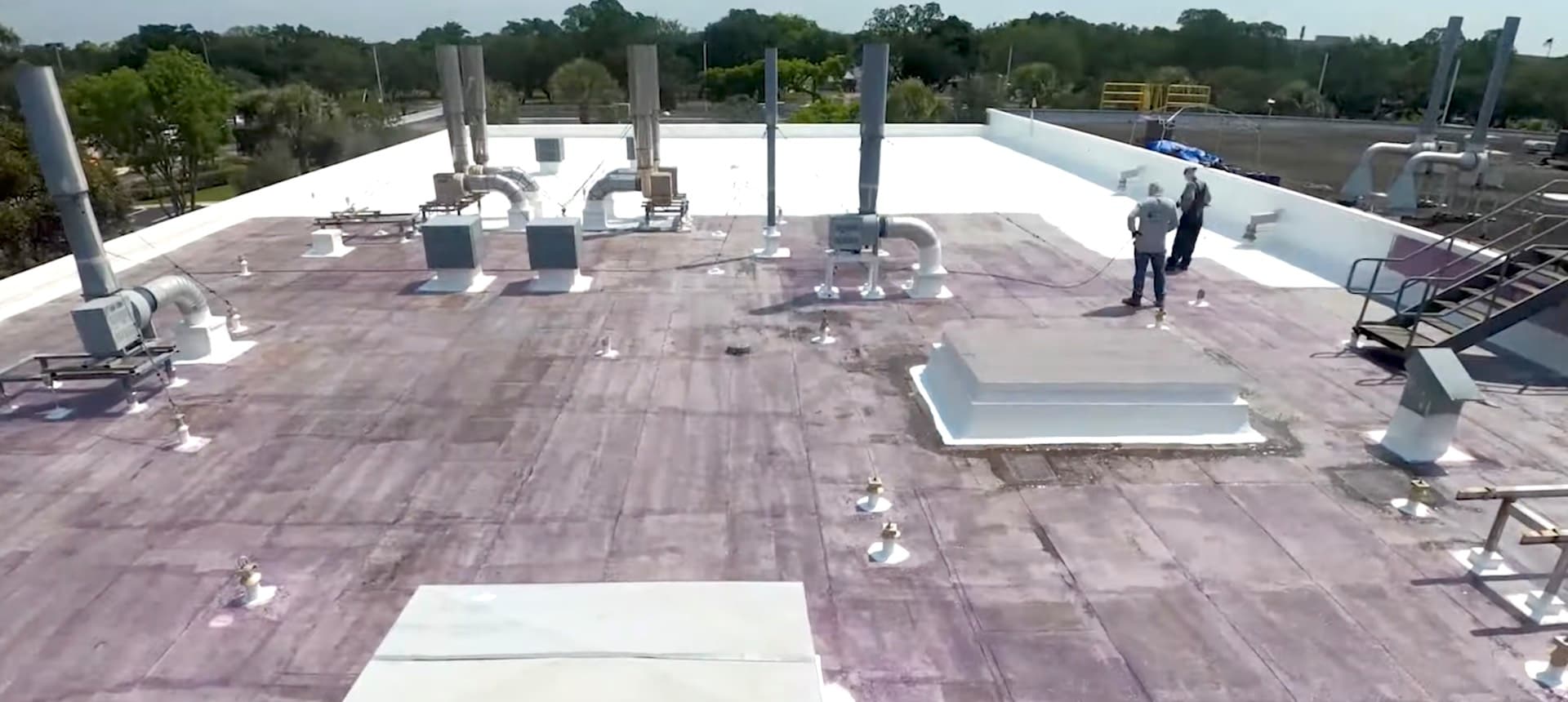
A leaking industrial roof in the Pacific Northwest doesn’t drip during a storm and dry out the next day — it stays wet for months. Production lines move buckets, maintenance budgets bleed, and every freeze-thaw cycle in January pries small leaks into bigger ones. Tear-off and replacement is the loud answer. There’s a quieter, faster, smarter one that most facility managers haven’t priced out yet.
Why PNW Roofs Fail Differently
If you manage a plant in Washington, Oregon, Alaska, or Northern Idaho, your roof isn’t fighting the same battle as one in Phoenix or Houston. The Sun Belt gets storm events. The PNW gets sustained wetness — 150+ rainy days a year, weeks of saturation, and freeze-thaw cycles that exploit every micro-crack in the system.
The failure pattern is predictable. Built-up roofs (BUR) develop seam separation as bitumen ages. Single-ply membranes — TPO, EPDM, PVC — lose seam adhesion and lift at the edges. Metal roofs back out fasteners. Small problems at seams, fasteners, skylights, and penetrations turn into bigger ones over years of saturation. In a production facility, water on equipment is a maintenance ticket; water on product is a recall.
The Case for Coating Over Tear-Off
Full roof replacement on an industrial facility means tearing off existing material, hauling it to landfill, exposing the deck mid-project, and either shutting down or relocating operations underneath. For a typical 50,000-square-foot production roof, that’s a multi-week project running into the high six figures.
Liquid-applied coating systems take a different path: clean the existing roof, condition the surface, and apply a seamless polymeric membrane over the top. No tear-off, no exposed deck, operations continuing underneath. Done correctly, the result is a fully-bonded membrane that turns a tired roof into a rain-proof one for another 15–20 years.
Belzona Fact:
Belzona’s field data points to a simple truth: roughly 90% of roof leaks come from about 10% of the roof — joints, seams, skylights, glazing bars, flashings, parapet walls, gutters, and penetrations. For many PNW facilities, the right answer isn’t a full re-coat. It’s a targeted application at the leak zones, with the rest of the roof inspected and left alone if it’s still serviceable.
The Belzona Product PNW Toolkit
Belzona’s liquid-applied roof system isn’t one product — it’s three, each with a specific role on a PNW roof.
Belzona 3111 (Flexible Membrane) is the long-term workhorse — a single-component, water-based acrylic, cold-applied by brush, roller, or airless spray. Used with Belzona 9311 reinforcement sheet, its microporous structure lets trapped substrate moisture escape upward, which is critical on damp PNW roofs. BBA, Miami-Dade, and Energy Star certified, with documented service life past 25 years on properly prepped substrates.
Belzona 3121 (MR7) is the emergency-repair specialist. It bonds to most roof substrates and cures even when fully immersed in water — so when a leak shows up Friday afternoon, 3121 goes down in adverse weather and starts working immediately. Ideal at expansion joints, seams, parapet walls, and active leak points.
Belzona 3131 (WG Membrane) is the cold-and-wet weather product, engineered for application in all conditions including PNW winters. A moisture-activated urethane that cures down to 32°F and resists rain immediately after application — the right choice for jobs that have to happen November through March.
Substrate Matters: BUR, Single-Ply, and Metal
Not every coating bonds to every substrate the same way, and the surface conditioner matters as much as the topcoat:
• Built-up and bituminous roofs: Power-wash, then prime with Belzona 3911 (PSC Surface Conditioner) before topcoat.
• Single-ply membranes (TPO, EPDM, PVC): Verify compatibility, clean thoroughly, and use the manufacturer-specified primer.
• Metal roofs: Address corrosion at fasteners, treat with the appropriate metallic primer (e.g., Belzona 3921), then apply the membrane — paying special attention to seams and fastener heads.
For almost every common industrial roof substrate, there’s a documented Belzona system path that handles it without tear-off.
Surface Prep and Weather Windows in PNW Conditions
The biggest objection from PNW facility managers: “When are you actually supposed to do this work?”
This is where the three-product range matters. Belzona 3111 needs reasonably dry conditions and 2–6 hours between coats — a spring-through-fall product here. Belzona 3131 is the cold-and-wet specialist, opening shoulder-season and winter shutdown windows. Belzona 3121 handles emergency work when you can’t wait at all. There’s almost no month when the right Belzona system can’t be applied somewhere on a PNW industrial roof.
Pro tip
If 90% of leaks happen at 10% of the roof, that 10% is where your Belzona-certified applicator’s attention should land first. Get the skylights, expansion joints, flashings, and penetrations sealed properly with reinforcement sheet and detail work — the rest of the project gets simpler, faster, and cheaper.
Service Life, Cost, and What to Expect
For a typical PNW industrial roof refurbishment with Belzona systems:
• Service life: 15–20 years on a well-prepped existing roof — often longer on lower-traffic structures, with 25+ years documented on 3111 applications.
• Cost: Typically 30–50% of full tear-off and replacement, with the savings coming from skipped tear-off, disposal, and decking exposure.
• Disruption: Minimal. No tear-off, no exposed deck, low-odor materials usable over occupied production space.
• Schedule flexibility: With 3131 in the toolkit, application is possible across a far wider weather window than conventional roof systems allow.
For most PNW facility managers, the math is decisive: spend less, disrupt less, recover the productive life of the roof, and revisit full replacement on your schedule — not a leak’s.
Bringing It Together
“Roof coatings” is a crowded category, and a lot of what’s sold under that label won’t survive a PNW winter. Belzona’s polymeric membrane systems are different: a product (3131) engineered for cold-and-wet application, and a field-proven understanding that most roofs need targeted repairs at the 10% where leaks actually happen. If your roof is dripping into production, ponding after every rain, or showing seam separation that’s getting worse year over year, evaluate a coating system before the next storm — not after.
Ready to evaluate your roof? Walk us through what you’re seeing — current substrate, problem areas, and your shutdown calendar — and we’ll help determine which Belzona system is the right call. Describe your problem through our contact form, or call us directly to make a site-visit appointment, or talk through your facility with a Belzona-certified technician serving Washington, Oregon, Alaska, and Northern Idaho.