Conveyors | Hoppers | Chutes | Pipe Elbows | Grinding Mills | Screw Conveyors
Abrasion Resistant Linings
Extend equipment life 10-20x with ceramic and elastomeric coatings engineered for severe abrasive environments.
Understanding Abrasive Wear
Abrasion is one of the most common forms of equipment wear — and one of the most expensive. Every piece of equipment in contact with foreign bodies experiences abrasive wear, from fine particles flowing through pumps to coarse materials sliding down chutes. The process cannot be completely stopped, but the right protective system can extend equipment life from months to years.
Selecting the correct abrasion-resistant system depends on understanding the wear mechanism. Key factors include media type (liquid or solid), particle size and hardness, moisture content, temperature, and most importantly — the angle of impact. Low-angle sliding wear requires different protection than high-angle impact wear.
Belzona offers a complete range of ceramic-filled metal repair composites and elastomeric coatings, each engineered for specific abrasion mechanisms. With ASTM-tested performance data and decades of documented applications, we can recommend the right system for your environment — and back it with local technical support throughout the Pacific Northwest.
Sliding Abrasion (Ductile Wear)
Material removal due to cutting or ploughing. Occurs when the angle of impact is less than 30° — particles sliding across surfaces.
Common in: Chutes, hoppers, conveyor beds, pipe runs
Impact Abrasion (Brittle Wear)
Material removal due to crack formation from direct impact. Occurs when the angle of impact approaches 90° — particles striking surfaces.
Common in: Pipe elbows, cyclones, impact zones, drop boxes
Product Selection by Application
Belzona offers two product families for abrasion protection — ceramic-filled composites for metal surfaces and elastomeric coatings for flexible or impact-absorbing applications.
1800 Series — Ceramic Composites
High-performance ceramic-filled epoxies for severe abrasion on metal substrates. Choose based on particle size and wear mechanism.
- 1811Ceramic Carbide — Coarse particle abrasion, maximum wear resistance
- 1812Ceramic Carbide FP — Fine particle abrasion, smooth finish
- 1813Ceramic Carbide SF — Super fine particles, fluid flow applications
- 9811Reinforcement Sheet — Added impact resistance for high-wear zones
2000 Series — Elastomeric Coatings
Flexible, rubber-like coatings that absorb impact energy and resist abrasion through elasticity rather than hardness.
- 2100Series — General purpose elastomeric repair and protection
- 2200Series — High-build coatings for severe erosion environments
- 2300Series — Conveyor belt repair and rubber replacement
Elastomerics excel where impact absorption matters — mixer blades, pump linings, and equipment handling larger particles at high velocity.
ASTM-Tested Performance
Taber Abrasion (ASTM D4060)
Standardized wheel-on-sample testing measures material loss under controlled abrasive conditions. Lower volume loss = better abrasion resistance.
Results published on each product specification sheet.
Slurry Abrasion (ASTM G65)
Rotating drum testing simulates real-world slurry and solids handling environments. Coated rods are measured for volume loss after exposure.
More indicative of field performance than laboratory hardness tests alone.
All test data available on Belzona product specification sheets. Contact us for specific performance comparisons for your application.
Applications
Conveyor Systems
Belt repairs, drive rollers, idler housings, and conveyor beds handling abrasive bulk materials.
Hoppers and Chutes
Line interior surfaces to protect against sliding abrasion from bulk solids. Extend hopper life from months to years.
Pipe Elbows
Protect high-wear areas where slurry or solids change direction. Critical for maintaining flow and preventing leaks.
Screw Conveyors
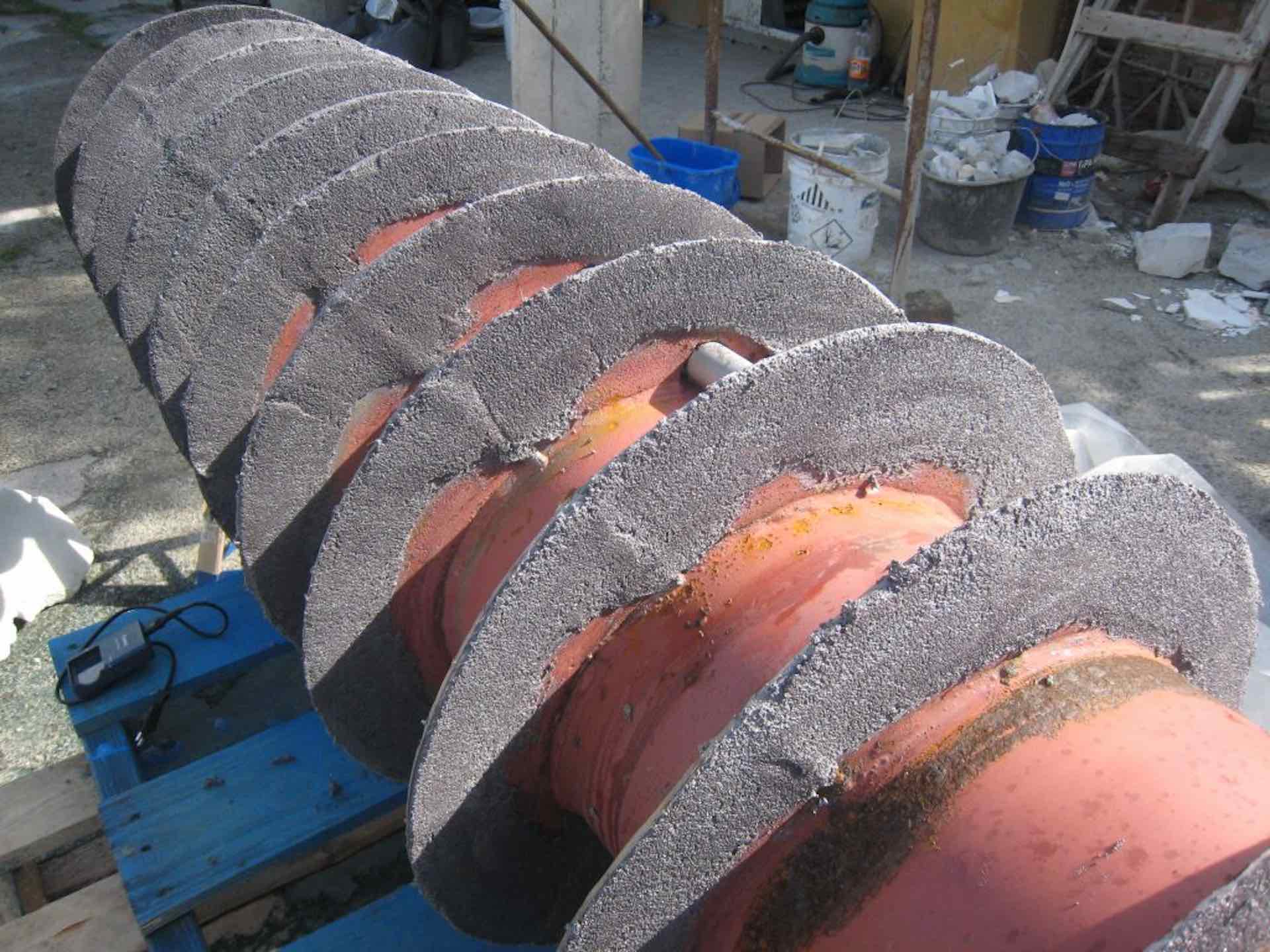
Rebuild worn flights and protect blade edges from abrasive slurries and dehydrated solids.
Grinding Mills
Protect mill internals, discharge chutes, and classifier components from severe grinding abrasion.
Mixer Blades
Rebuild worn edges and protect blade surfaces with elastomeric coatings that absorb impact energy.
Industries Using Abrasion Resistant Linings
Mining
Slurry lines, cyclones, classifiers, ore chutes, conveyor systems, and grinding mill components.
Pulp and Paper
Debarker drums, chip conveyors, stock pumps, and fiber handling equipment.
Power Generation
Coal handling, ash systems, FGD equipment, and cooling water pump internals.
Water and Wastewater
Grit chambers, screw conveyors, clarifier equipment, and sludge handling systems.
Agriculture
Grain handling, seed processing, fertilizer systems, and harvest equipment.
Food and Beverage
Sugar processing, flour milling, ingredient handling, and FDA-compliant conveyor systems.
Frequently Asked Questions
What causes abrasion in industrial equipment?
Abrasion is caused by foreign particles moving over a surface — typically mineral particles in slurries, bulk solids, or process streams. The severity depends on particle size, hardness, shape, velocity, moisture content, temperature, and angle of impact against the surface.
What is the difference between sliding and impact abrasion?
Sliding abrasion occurs when particles move across a surface at low angles (under 30°), cutting or ploughing material away. Impact abrasion occurs at high angles (near 90°), causing material removal through cracking and fracture. Different coatings perform better for each type.
How do you protect steel from abrasive wear?
Steel can be protected with ceramic-filled epoxy coatings for fine-to-medium particle abrasion, or elastomeric coatings that absorb impact energy from larger particles. The right choice depends on particle size, impact angle, and operating conditions. Both can be applied in the field without hot work.
Is ceramic coating better than rubber lining for abrasion?
It depends on the wear mechanism. Ceramic coatings excel against fine particles at low impact angles — think sliding wear in chutes and hoppers. Rubber and elastomeric coatings perform better against larger particles at high impact angles, where flexibility absorbs energy. We often recommend ceramics for sliding wear and elastomerics for impact zones.
How do you stop wear on conveyor chutes?
Conveyor chutes typically experience sliding abrasion from bulk materials. Belzona ceramic coatings (1811, 1812, or 1813 depending on particle size) create a hard, wear-resistant surface that dramatically extends chute life. For impact zones where material drops onto the chute, elastomeric linings may be combined with ceramics.
What is the best liner material for hoppers?
For most bulk solids handling, ceramic-filled epoxies like Belzona 1812 provide excellent protection. In documented applications, hoppers that lasted 1 month unprotected achieved 18-24 months of service with Belzona linings — even handling abrasive materials 24/7. The specific product depends on your particle size and whether wet or dry.
How do I choose an abrasion resistant coating?
Start with the wear mechanism: sliding (low angle) or impact (high angle). Then consider particle size — coarse particles need different products than fine particles. Finally, factor in moisture, temperature, and chemical exposure. Contact us with your specific conditions and current equipment life, and we will recommend the right system.
How long do abrasion resistant linings last?
Properly specified Belzona systems routinely extend equipment life 10-20x compared to unprotected steel. Actual service life depends on abrasion severity, but we have documented hoppers lasting 18-24 months versus 1 month unprotected, and screw conveyors operating years beyond their original lifespan.
Abrasion Wearing You Down?
Describe your equipment, the material being handled, and current wear rates. We will recommend the right Belzona abrasion resistant system — backed by ASTM test data and local Pacific Northwest support.
Belzona Technology Northwest is the exclusive authorized Belzona distributor for Washington, Oregon, Alaska, and Northern Idaho. Abrasion resistant linings, ceramic coatings, and elastomeric protection systems — with local technical support throughout the Pacific Northwest.