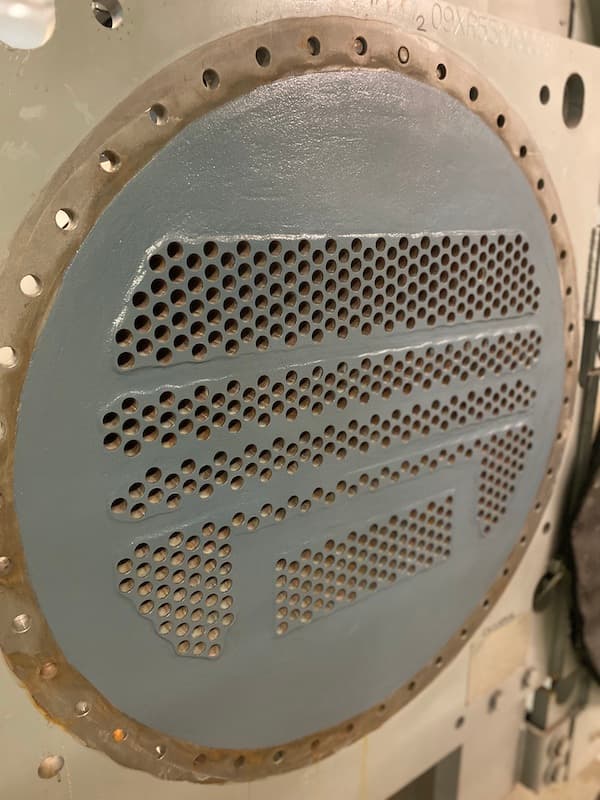
A leaking heat exchanger in a Pacific Northwest pulp mill, refinery, or power plant doesn’t just mean a maintenance ticket — it means six-figure daily losses, missed production targets, and capital decisions you’d rather not be making on a Friday night. Retubing or full replacement runs weeks of downtime and devours capital budgets. Before committing to either, there’s a third option most operators overlook: polymeric heat exchanger refurbishment.
Why Heat Exchangers Fail in Pacific Northwest Facilities
If you’re running heat exchangers in Washington, Oregon, Alaska, or Northern Idaho, you already know the conditions are brutal. Pulp and paper mills push corrosive process fluids and pulp slurries through tubes that thermal-cycle hundreds of times a year. Power generation plants — hydro, gas, biomass — see continuous galvanic corrosion at carbon-steel tube-to-tubesheet joints where dissimilar metals meet cooling water. Food and beverage processors deal with CIP chemistries and thermal shock. Refineries face the worst of all worlds: erosion from particulates, acidic condensates, and aggressive process streams.
The result is predictable. Heat transfer efficiency drops as deposits and corrosion build. Pinhole leaks appear at tube ends. Eventually you’re losing tubes faster than you can plug them, and the unit comes off-line whether you planned for it or not.
Pro tip
Rising approach temperature is one of the earliest signs of fouling, scaling, or under-deposit corrosion. If your delta-T is creeping up over months, you have time to plan a coating job. If you’re seeing leaks, you’re already in reactive mode — and your options narrow fast.
When Coating Is the Right Call — and When It Isn’t
Belzona’s polymeric heat exchanger protection systems aren’t a universal answer. Here’s the honest framing.
Coating is the right call when:
• Tube sheets and waterboxes show corrosion, pitting, or erosion damage but the tube bundle itself is still serviceable
• You’re seeing galvanic corrosion at tube-to-tubesheet joints
• You want to extend service life 5–10 years and defer a capital retube
• You need to be back online inside a typical maintenance shutdown window (3–7 days)
Replacement or retubing is the right call when:
• Tube wall thickness is below minimum spec across the bundle
• You have widespread tube-side leaks, not just tube-end attack
• The shell itself is structurally compromised
• Process upgrades require different metallurgy or tube geometry
The decision usually comes down to a UT thickness survey of the tubes plus a visual of the tube sheet face. If the bundle is sound and the damage is at the surfaces, coating is almost always the faster, cheaper path.
The Belzona System for Heat Exchanger Protection
Three Belzona products do the heavy lifting on most PNW heat exchanger jobs, each with a distinct role in the refurbishment stack.
Belzona 1311 (Ceramic R-Metal) is the rebuilding workhorse — a two-part epoxy reinforced with silicon carbide and ceramic fillers, used to restore corroded or eroded tube sheet faces and waterbox surfaces back to original profile. It’s 100% solids, cures at ambient temperature, and requires no hot work, which makes it usable in shutdown windows where welding isn’t practical.
Belzona 1321 (Ceramic S-Metal) is the smooth topcoat that goes over 1311 (or directly onto a properly prepped substrate). Brushable and ceramic-filled, it gives the tube sheet face a low-friction surface that reduces turbulence at fluid entry, improves flow efficiency, and resists most cooling waters and process fluids.
Belzona 5811 (Immersion Grade) is the long-term protective coating for the surrounding waterbox and end covers, formulated specifically for continuous immersion service. It cures at ambient temperatures common in PNW shutdown windows and offers strong chemical resistance to typical cooling-water chemistries.
The typical refurbishment stack: rebuild damaged areas with 1311, apply 1321 as the smooth topcoat over the tube sheet face, and protect the surrounding waterbox with 5811. Every joint, every transition, fully sealed against the cooling-water side.
Surface Prep and Application in a Real Shutdown Window
This is where coating projects succeed or fail. Belzona systems require:
1. Abrasive blast to a near-white metal finish (SSPC-SP 10 / NACE No. 2) with a minimum 75-micron (3 mil) angular profile.
2. Dry, contaminant-free surface at application — meaning you’re tracking dew point, not just temperature. PNW shoulder-season shutdowns can be humid, and condensation kills adhesion.
3. Application within the recoat window of the chosen system — typically a few hours between rebuild and topcoat at ambient temperatures.
4. Cure time before return to service — generally 24–48 hours at typical PNW shutdown temperatures, faster with mild heat.
Warning
The most common cause of premature coating failure in PNW heat exchanger jobs is application over a substrate that’s at or below dew point. Surface temperature must be at least 5°F above dew point during application and through initial cure. A contact thermometer and a sling psychrometer are non-negotiable on every job.
Cost and Turnaround vs. Traditional Repair
For a typical shell-and-tube unit with tube sheet and waterbox refurbishment:
• Polymeric refurbishment: 3–7 days downtime; cost typically 20–40% of retube. Extends service 10+ years on the protected surfaces.
• Retube: 2–6 weeks depending on bundle pull, fabrication lead time, and re-installation. Full capital project.
• Full replacement: 3–12 months including spec, fabrication, delivery to the PNW, and installation.
For most plants we work with, the math is straightforward. A coating refurbishment lets you defer the capital project, run cleaner heat transfer for years, and plan the eventual retube on your schedule rather than the failure mode’s.
Bringing It Together
Heat exchanger tube coating, tube sheet coating, and waterbox protection aren’t a way to avoid eventual replacement — they’re a way to control when and how that replacement happens. For Pacific Northwest pulp mills, power plants, food processors, and refineries running aging units, that control is worth real money.
If you have a heat exchanger underperforming, leaking, or coming up in your next shutdown, the right time to evaluate coating versus replacement is now — not when the unit forces the decision.