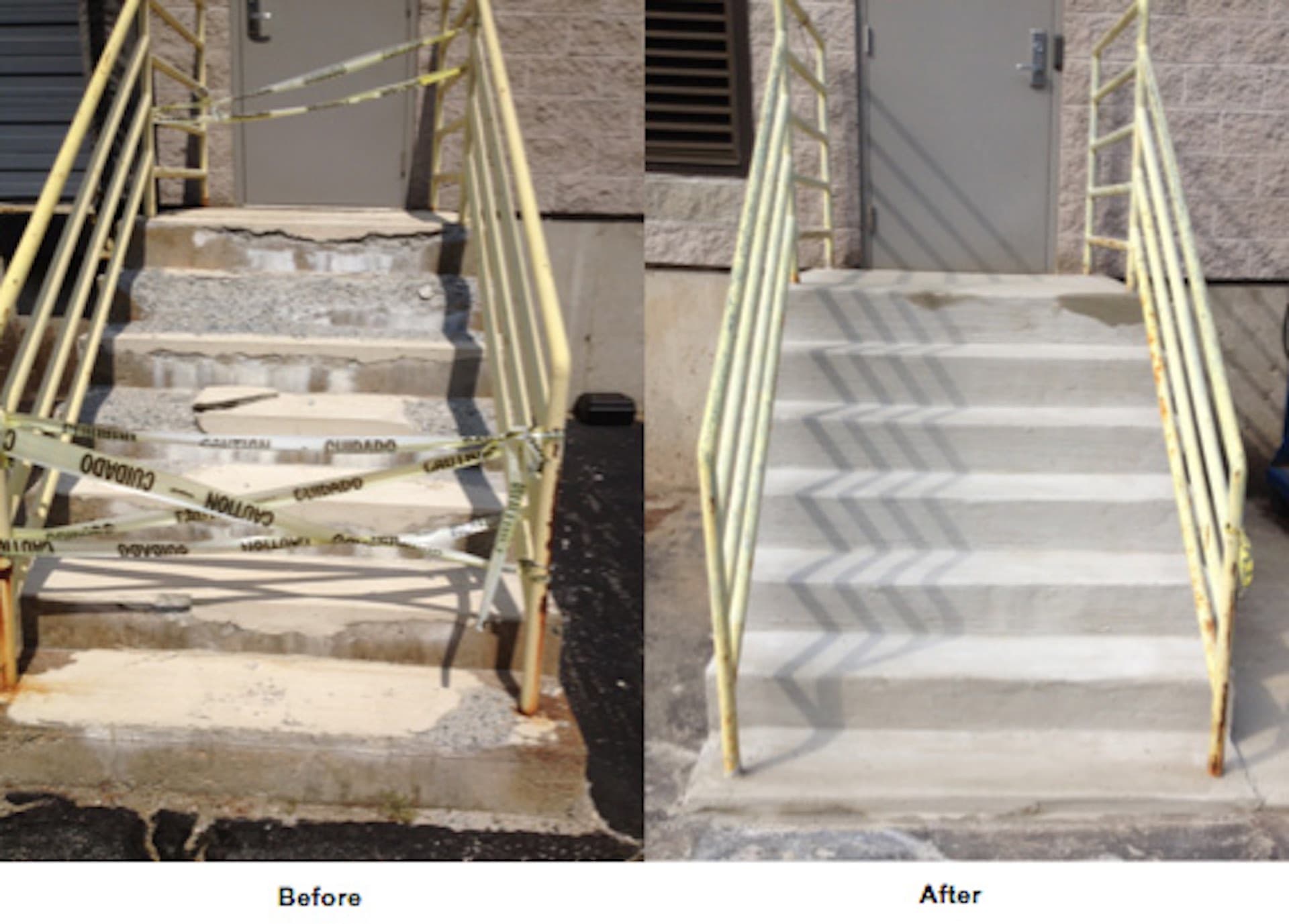
Concrete is supposed to be permanent. But anyone managing facilities in Washington, Oregon, or Alaska knows better. The Pacific Northwest's relentless wet climate—200+ days of precipitation annually in many areas—creates conditions that systematically destroy concrete structures. Wastewater treatment plants, secondary containment areas, loading docks, and process floors all face the same slow-motion failure: spalling, cracking, and surface deterioration that traditional patch repairs can't seem to stop.
The problem isn't the concrete itself. It's what happens when moisture gets inside—and in the PNW, moisture always gets inside.
Why Concrete Fails in Wet Climates
Concrete is porous. Even well-mixed, properly cured concrete contains microscopic voids and capillaries that absorb water. In dry climates, this moisture cycles in and out without major consequences. In the Pacific Northwest, concrete stays saturated for months at a time, and that's where the damage begins. Then the heat of summer pushes the moisture content to single digits. Back and forth it goes, season after season.
Freeze-thaw cycling is the primary killer. When absorbed water freezes, it expands roughly 9% in volume. That expansion creates internal pressure that cracks the concrete matrix from within. Each freeze-thaw cycle—and Western Washington can see 30-50 cycles per winter—propagates those cracks further. Surface spalling appears first, followed by deeper structural deterioration.
Chemical attack compounds the damage, particularly in industrial settings. Wastewater facilities expose concrete to hydrogen sulfide, which converts to sulfuric acid above the waterline. Secondary containment areas see chemical spills that penetrate porous surfaces. Even road salt tracked into facilities attacks concrete flooring.
Reinforcement corrosion follows moisture ingress. When water carrying chlorides or other contaminants reaches embedded rebar, corrosion begins. Rust expands to 6-10 times the volume of the original steel, creating internal pressure that cracks and delaminates the concrete cover. Once this process starts, it accelerates—each crack admits more moisture, which causes more corrosion.
Abrasion and impact wear away surfaces in high-traffic areas. Forklifts, pallet jacks, and foot traffic grind down concrete floors. Loading docks take constant abuse from truck traffic and dropped loads. Without the surface density to resist wear, concrete deteriorates layer by layer.
Pro tip
Test suspect concrete with a hammer. Solid concrete rings; deteriorated concrete sounds hollow or dull. Areas that sound hollow have already delaminated from the substrate—they'll need to be removed completely before repair, not just coated over.
Why Traditional Concrete Patches Fail
"We see all of the above, in the Pacific Northwest, so unprotected exterior concrete can get pretty bad, pretty fast", says Travis Korda with Belzona Technology Northwest. The standard approach to concrete repair—cut out the damaged area and fill with Portland cement-based patching compound—has a fundamental problem in wet climates: the repair material shares all the weaknesses of the original concrete.
Cement-based patches are porous. They absorb moisture. They're vulnerable to freeze-thaw. They have relatively low tensile strength and bond weakly to existing concrete, especially if the substrate isn't perfectly dry and clean. In the perpetually damp conditions of PNW facilities, achieving a truly dry substrate is often impossible without extensive preparation and downtime.
The result: patches that crack, debond, and fail within a few years—sometimes within months. Maintenance crews find themselves repairing the same areas repeatedly, spending more on cumulative patches than a proper repair would have cost initially.
For wastewater plants and secondary containment areas, failed patches create compliance issues. Regulatory agencies don't accept "we patched it" as evidence of adequate containment. When patches crack, the underlying concrete is again exposed to chemical attack, and the cycle repeats.
Epoxy Mortar Solutions for Wet-Climate Concrete
High-strength epoxy mortars address the failure modes that defeat cement-based repairs. These two-component systems combine epoxy resins with aggregate fillers to create repair materials that are:
• Non-porous — no moisture absorption, no freeze-thaw damage
• Chemically resistant — withstand acids, alkalis, and industrial chemicals
• High-strength — compressive strengths of 10,000+ psi, far exceeding standard concrete
• Strongly bonded — mechanical and chemical adhesion to properly prepared substrates
• Tolerant of damp conditions — can be applied to damp (not wet) concrete
For Pacific Northwest facilities, three Belzona products address different concrete repair scenarios:
Belzona 4111 (Magma-Quartz) is the heavy-duty rebuilding material. This epoxy composite uses quartz aggregate to achieve compressive strengths exceeding 12,000 psi—roughly three times stronger than standard concrete. It's designed for rebuilding damaged areas, filling spalled sections, and restoring structural profiles. For deep repairs on containment walls, loading docks, or process floors, 4111 provides the mechanical strength to handle ongoing service loads.
Belzona 4131 (Magma-Screed) resurfaces deteriorated concrete floors. This self-smoothing epoxy screed can be applied from feather edge to 1/4 inch in a single application, creating a dense, chemical-resistant wearing surface. For wastewater facilities with widespread surface deterioration—but sound underlying concrete—4131 restores the floor without full-depth reconstruction.
Belzona 4141 (Magma-Build) handles vertical and overhead repairs where self-leveling materials won't stay in place. This thixotropic epoxy composite can be troweled onto walls, columns, and ceiling surfaces to rebuild damaged areas. For secondary containment walls showing spalling or chemical attack, 4141 restores the surface while providing ongoing protection.
PRODUCT HIGHLIGHT:
Belzona 4111 (Magma-Quartz) delivers compressive strength of 12,400 psi and bonds to damp concrete substrates—critical for PNW facilities where achieving bone-dry conditions is impractical. The material resists a wide range of chemicals and withstands heavy traffic and impact loads.
Application Considerations for PNW Facilities
Surface preparation determines repair longevity. Remove all loose and deteriorated concrete until you reach sound substrate—the "hollow hammer" test helps identify boundaries. Surfaces should be roughened to provide mechanical key; abrasive blasting or scarifying works well.
Substrates can be damp but not wet. Remove standing water and allow surfaces to reach a "saturated surface dry" condition. In covered areas, this is usually achievable. For outdoor repairs during rainy periods, temporary shelter may be necessary.
Cure times extend in cold weather. At 50°F, allow 24-48 hours before returning repairs to service; at 40°F, extend to 48-72 hours. For critical areas that can't tolerate extended downtime, schedule repairs during warmer dry periods—typically July through September in Western Washington.
For secondary containment areas requiring chemical resistance beyond the base repair, consider topcoating with Belzona 4311 or 4341 after the structural repair cures. This creates a seamless, impermeable barrier that meets containment requirements.
Long-Term Value for PNW Facilities
Epoxy mortar repairs cost more per square foot than cement-based patches—typically 3-5 times more for materials alone. But the lifecycle economics favor epoxy in wet climates:
• Cement patch lasting 2-3 years, replaced 4 times over a decade: 5x material cost + 5x labor
• Epoxy repair lasting 10+ years: 1x material cost + 1x labor
For wastewater facilities, secondary containment areas, and other regulated environments, the compliance benefits add further value. Inspectors recognize the difference between repeated patch repairs and engineered solutions designed for the exposure conditions.
Ready to address concrete deterioration at your facility? Contact us at (425) 610-4902 or describe your situation through our contact form. We provide concrete repair assessments and material supply throughout Washington, Oregon, Alaska, and Northern Idaho.